I’d heard that Toyota, in Japan, had added all-wheel-drive
technology to its Prius being sold there, so, at a meeting in Denver three
years ago I asked Toyota executive David Lee if the company might do the same
in Colorado.
“Probably not,” he said, adding that “the Prius has aimed
its volume sales at sunshine states and to expect it, with an all-wheel-drive
addition, to move into cold and snowy country would be a contradiction to the
basis of the hybrid electricity success.”
But thinking changes, sometimes along the lines of a sales
decline, of which the Prius has encountered in recent months.
“Yes, the time has come,” said Lee at the 2019 Denver Auto
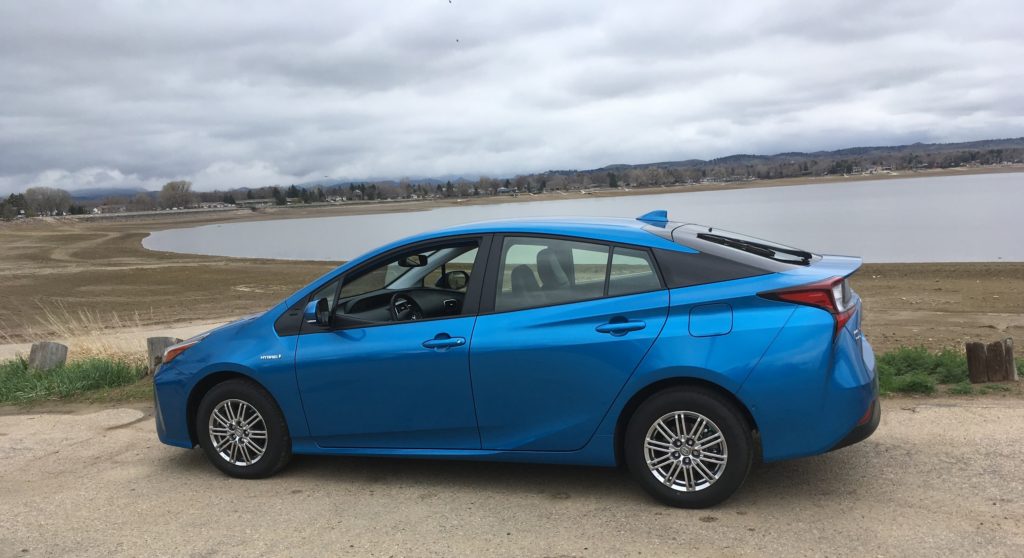
Show. And delivered to me was the 2019 Toyota Prius XLE AWD-e Hybrid. It isn’t
a fully capable all-wheel-drive hatchback, but it has the basis for some assist
from all four wheels.
For the front-wheel-drive Prius, Toyota has added a
lightweight, 7-horsepower, magnetless electric motor to the rear wheels. From 0
to 6 miles an hour, the e-motor is automatically engaged, helping with startup
speed and lending grip in icy conditions. From 6 to 43 mph, the AWD system is
engaged only as needed, and, beyond 43, there is no AWD available. Thus, the
Prius remains lacking for serious cold, snowy weather areas.
The Prius was one of the first gas/electric hybrids to come
on the scene in the U.S., in 2000, and thoroughly dominated sales until three
or four years ago, when large numbers of new hybrids took away sales. I’ve always
considered the Prius one of the best of the hybrids for fair-weather driving.
The e-AWD model, with the boost to 6 miles per hour, was
strong in takeoffs. The system offers driving modes of eco, power and
electric. My overall fuel-mileage
average was 51.8 mpg.
Sticker price for the Prius AWD-e reached $32,146, including Entune audio, color head-up display, heated steering wheel, rain-sensing wipers, dynamic radar cruise, brake assist, lane-departure alert and blind-spot monitor.
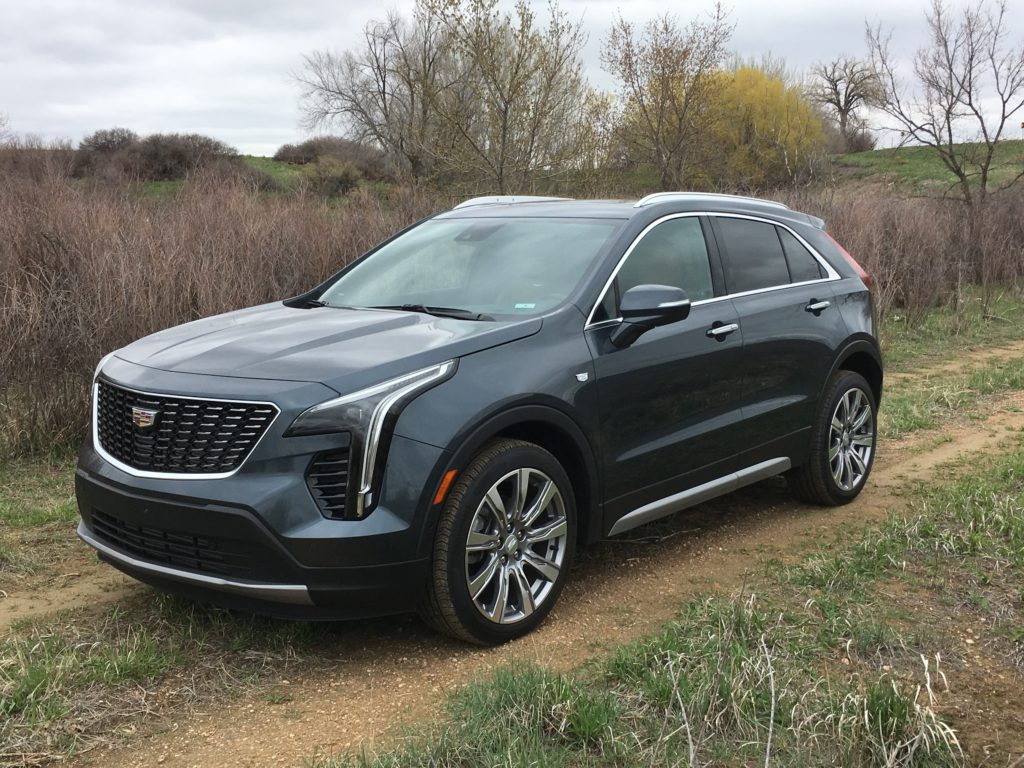
The new 2019 Cadillac XT4 is one of larger luxury subcompact SUVs. (Bud Wells photos)
The littler
luxuries (subcompacts) are latecomers to the years’-long takeover of the U.S.
car market by SUVs and crossovers.
The newest of
the newer premium luxury subcompacts are the Cadillac XT4 and Lexus UX, showing
up in November and December.
Smaller than the Cadillac is the new Lexus UX, this one a hybrid.
They do sales
battles with Audi Q3, BMW X1 and X2, Infiniti QX30, Jaguar E-Pace, Mercedes
GLA-Class, Range Rover Evoque and Volvo XC40. They’re not big sellers yet,
collectively capturing about 2 percent of the booming SUV/crossover market.
The XT4
retains the crisp, sharp, distinctive exterior lines of Cadillacs of recent
years, likened somewhat to current Acura styling.
The XT4’s structure
is one of the largest among luxury subcompacts; in fact, the new Cadillac is
occasionally referred to as a compact. It rides on a wheelbase of 109.4 inches,
is 181.1 inches in overall length, is 83.5 wide and 64.1 in height. Curb weight
is 3,876 pounds. The Lexus UX is 6 inches shorter and 250 pounds lighter.
The 2019 XT4
All-Wheel-Drive Premium Luxury review model came my way last week. It joins the
XT5 midsize crossover and the Escalade full-size SUV for Cadillac. Soon to
arrive will be the three-row XT6, which will fill a gap between the XT5 and
Escalade.
Of the
changing lineup for the brand’s SUVs/crossovers, Cadillac president Steve
Carlisle said, “The first-ever Cadillac XT6 delivers a compelling blend of
spaciousness, safety and convenience features. It joins the all-new XT4, which
has soared to the top spot in its segment, our global best-selling XT5 and the
iconic Escalade.”
A newly
designed 2.0-liter, turbocharged 4-cylinder engine of 237 horsepower and 258
lb.-ft. of torque teams with a 9-speed automatic transmission and twin-clutch
AWD system with torque vectoring and a front disconnect to boost fuel mileage
while in two-wheel drive.
Pushing the
drive mode button in the XT4, I was given choice of Touring two-wheel-drive
control, all-wheel drive or Sport AWD. Sport stiffens suspension and steering
feel, and with use of paddle shifters I put the Cad through some dry offroad
drills. It performed impressively, with good maneuvering grip, though with
ground clearance of 6.7 inches probably not a contender for wintertime Jeep
trails.
Response is
quick and relatively smooth for the Cadillac 4-cylinder, and fuel mileage is
decent, estimated at 22-to-29 miles per gallon. My overall average was 24.2.
The review
model’s interior is gorgeous, with Sedona leather of shades between gold and
caramel, contrasting perfectly with the black elsewhere. A centerstack juts
outward for easy control by driver or front-seat passenger, and features Bose
surround sound, providing phone connectivity with Apple CarPlay and Android
Auto.
Seating is
roomy and comfortable, with an average amount of cargo space, 22.5 cubic feet,
behind the rear seat.
Among options
pushing the XT4’s sticker price to $54,785 from a base of $41,795 are lane-keep
assist, automatic braking, adaptive cruise, front pedestrian braking, automatic
parking assist, hands-free liftgate, ventilated front seats, sunroof, head-up
display, navigation with real-time traffic, wireless charging and cabin air
ionizer.
The XT4 is
built in a Cadillac assembly plant in Kansas City, Kan.
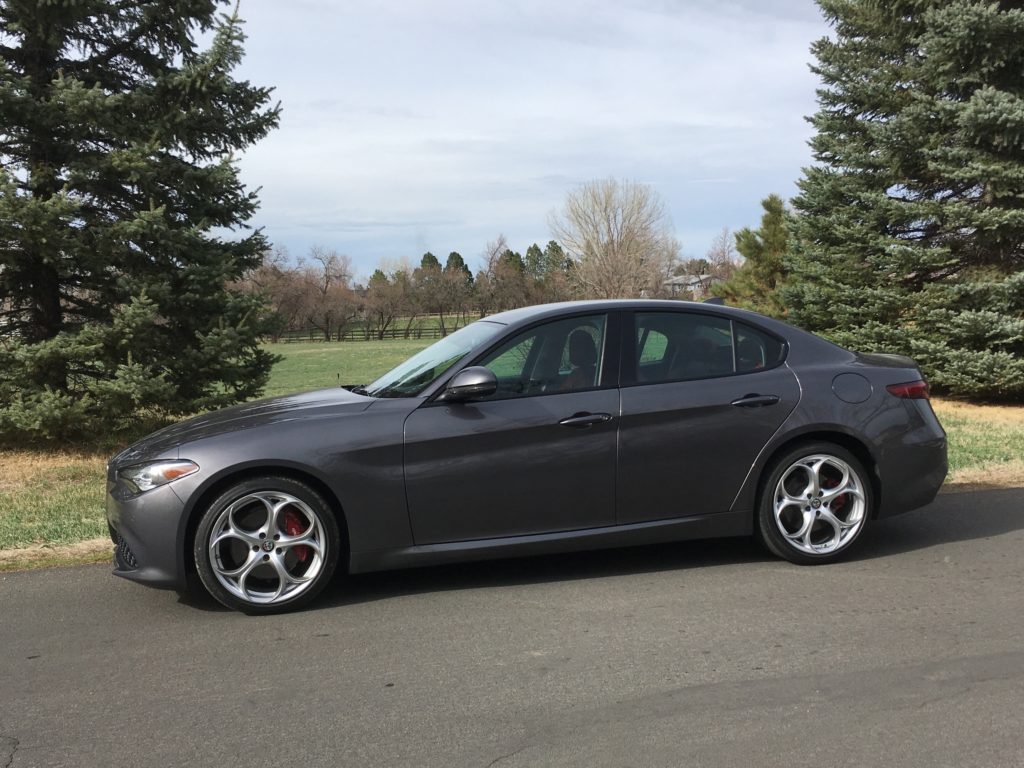
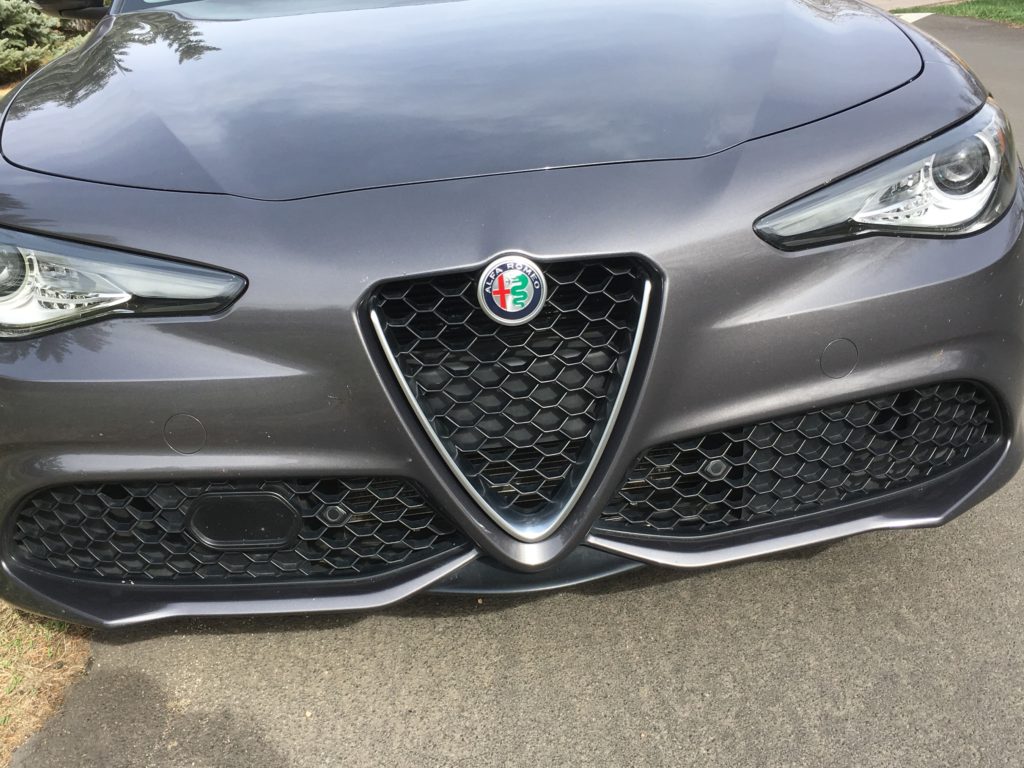
A lively sport sedan is the 2019 Giulia Ti all-wheel-drive model. (Bud Wells photos)
Curiosity
abounds all around, with regards to Alfa Romeo.
Few of the
Italian marque are seen in these parts, yet several times as I parked and
exited the 2019 Giulia sport sedan, someone would ask, “Is that an Alfa Romeo?”
The Alfa
brand, absent from the U.S. for 20 years until the 4C Spider in 2015, seems to
exude a level of respect whenever mentioned.
And its odd,
colorful badge (you know, the cross and the snake swallowing a man) draws
immediate attention. The red is the cross of the municipality of Milan, Italy,
where Alfa Romeo was founded, and the green snake is open to various
interpretations – take your pick.
The key to
liking the four-door Giulia is to drive it. I said that about the 2017 model
two years ago after maneuvering it into the Poudre Canyon, over Cameron Pass, down
to Walden and on up to Laramie.
The new model
I drove, the Giulia Ti Sport all-wheel drive, is the same – a great-handling,
rear-drive-based sedan. Move the drive mode from normal to dynamic, and the
crisper steering ties right into the brilliant handling and super grip.
Performance
comes from a 280-horsepower, 2.0-liter, 4-cylinder engine turbocharged with
direct-injection and mated to an 8-speed automatic transmission. It’s quick,
with 306 lb.-ft. of torque, and is a delight in the Rockies with manual-mode
shifting. Here’s where the flaw shows up – the 6 ½-inch-long aluminum paddles
locked to the steering column, they’re so large they have the look of a
shift-training setup for high school sophomores. Paddle shifters ought to be
small, out of the way except to the touch of a finger for upshift or downshift.
The Giulia
retained secure manners with its all-wheel-drive system in a late-season winter
test in the rain and snow.
The Giulia is
EPA-rated at 31 miles per gallon for highway driving; my overall fuel average
was a decent 27.8. Alfa boldly compares the sport sedan to the BMW 3 series and
Mercedes C Class, along with Volvo S60, Cadillac ATS and Audi A4.
Highlighting
its exterior are the V-grille and low-level front sport fascia.
V-grille and colorful badge are identifiers for Alfa Romeo.
Most inviting
in the Giulia’s interior, somewhat tight in the rear, are the red-finished
sport leather seats (heated in both rows). Trunk space is only 12 cubic feet.
Two optional
packages – added safety with forward-collision warning plus, adaptive cruise
with stop and lane-departure warning, and Ti Sport AWD special of dark aluminum
wheels and all-season performance tires, low-riding front sport fascia, red
brake calipers and sport leather seats – played important role in pushing the
Giulia’s $41,995 base price to a final sticker of $51,885.
Among other
options were Harman Kardon audio, Bluetooth, navigation, leather dash and
vesuvio gray metallic exterior paint.
Alfa Romeo,
owned by Fiat Chrysler Automobiles, produces the Giulia, 4C Spider and Stelvio
SUV for the U.S. market.
The Ford Courier was imported from Japan. (Bud Wells photo)
(My first review of a pickup was
40 years ago, the mini-built Ford Courier, which appeared in The Denver Post on
April 7, 1979. The Courier was provided by the Denver regional office of Ford
Motor Co. Following are excerpts:)
Nearly 10 percent of
new trucks sold in the U.S. last year were of the mini-pickup variety.
Driving about Denver
in a Ford Courier puts the growing popularity and acceptance of the little
units in an understandable light. Because of their small stature, the minis are
easy to handle, economical and they’ll carry a somewhat respectable load.
The optional 2300-cc,
4-cylinder engine is a good runner and strong enough to handle the duties
required of such a vehicle. Cold-blooded tendency is overcome with a manual
choke. Mechanically-minded purchasers will be delighted withal the room beneath
the hood.
Frequent downshifting
is required in city driving, but the 4-speed transmission is an easy shifter.
The Courier produced an average of 17.5 miles per gallon of fuel in
start-and-stop town driving. The EPA rates the Courier at 22 miles per gallon.
Built for Ford by Toyo
Kogyo of Japan, the Courier carries a base price of $4,861, including
white-sidewall tires, power front disc brakes, 6-foot box and 4-speed
transmission.
Optional items
included the 2300 engine (2000 is standard) for $174.20, AM push-button radio
for $78.90, tinted glass $28.30, swing-lock western mirrors $51.80 and rear
step bumper $83.60. Freight charges of $110 brought the pickup’s price to
$5,387.80. An unusual enclosed rear body was mounted on the Courier, pushing
the vehicle’s value to $7,094.55.
The Courier, on a
wheelbase of 106.9 inches, has a 1,400-pound capacity for cargo and passengers.
Wing windows aid ventilation in the cab, and the unit possesses a fast,
effective heater.
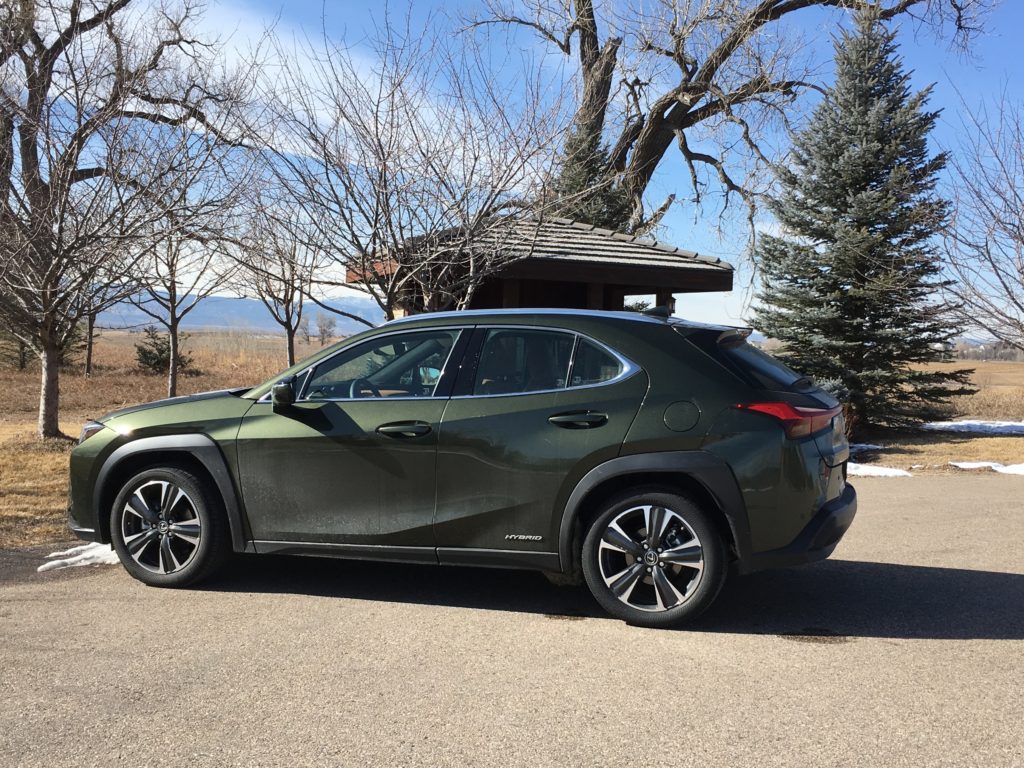
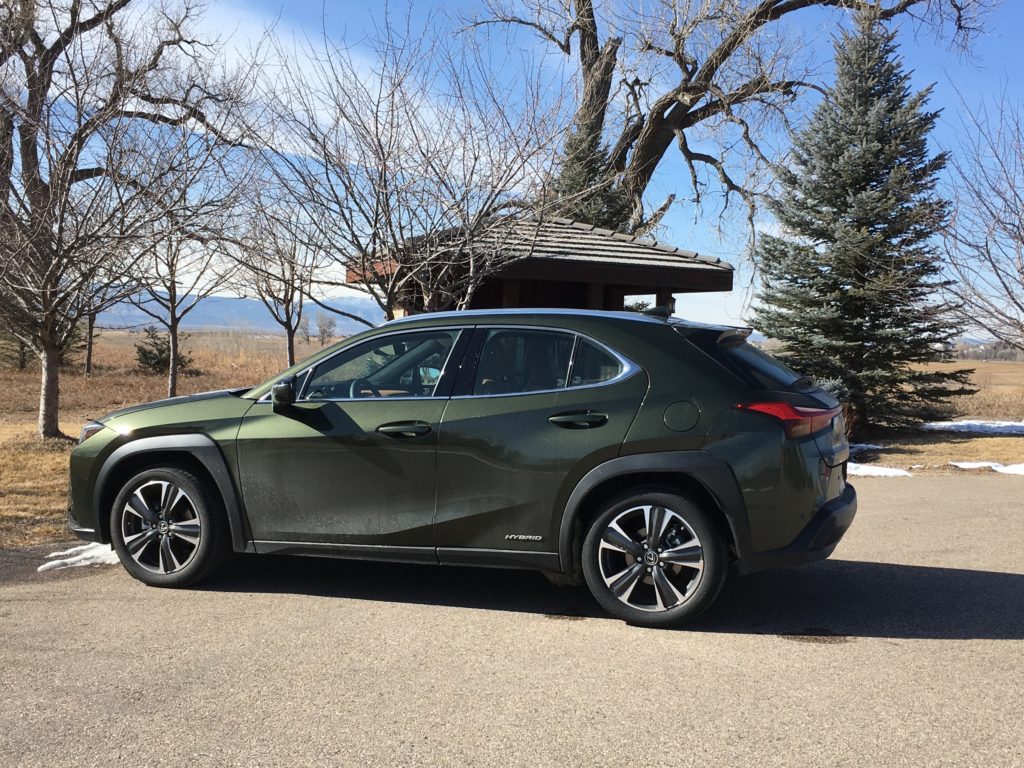
The new Lexus UX250h gets all-wheel drive from electric boost. (Bud Wells photo)
It’s an
odd-color green on the 2019 Lexus UX 250h all-wheel-drive review model I piloted
in February. Nori green pearl, Lexus calls it, somewhat like the olive green on
a Jeep.
This is no
Jeep. It is Lexus’ new luxury subcompact SUV, a hybrid which gains AWD
capability through use of an electric motor-generator which drives the rear
wheels. It is based on the platform of the fun-but-quirky-looking Toyota C-HR,
which showed up a year ago.
The
Japanese-built UX will battle for sales in the luxury subcompact category
against such strong entries as the Audi Q3, BMW X2, Cadillac XT4, Infiniti
QX30, Jaguar E-Pace, Mercedes-Benz GLA-Class, Range Rover Evoque and Volvo
XC40.
The UX 250h
all-wheel-drive model is powered by a 2.0-liter, 4-cylinder gas engine, an
electric motor up front and another at the back, where also is a nickel-metal
hydride battery pack. The motor at the rear is the source of power to the rear
wheels, as there is no driveshaft. The electric motor-generator drives the rear
wheels up to 45 miles per hour, and beyond that the UX performs in front-drive.
The gas/electric power sources are tied
to a continuously variable transmission.
The hybrid
addition lifts the UXh’s estimated fuel mileage to 41 in town and 38 on the
highway. My overall average was 33.2, reduced some by two mornings of driving
in 8-below-zero temperatures.
The new
subcompact is also offered in nonhybrid form as the Lexus UX200, a
front-wheel-drive vehicle with a 169-horsepower, 4-cylinder gas engine. The
UX250h, with its gas/electric combination, is rated at 181 horsepower. Its
electric boost off the line makes it quicker than the nonhybrid model.
The UX250h is
small, with a 103.9-inch wheelbase and overall length of 177 inches, yet
because of the battery pack and electric motors it carries a hefty 3,605-pound
curb weight. It rides on Bridgestone 225/50RF18 tires.
Space is very
tight in the rear cargo area; only 17 cubic feet, short of the 19-24 range of
its luxury subcompact competitors. I realized how short when our load of
supplies from Costco in Timnath had to be divided between the cargo and rear
seats. It’s the battery pack and a sloped roofline that steal away space, for
the non-hybrid version of the UX has available more cubic feet than the hybrid.
Golden
leatherette-finished seats (heated and cooled) and dash pads embellished the
interior. Some difficulty arose with use of the remote touch controller for
infotainment, though the simple and quick-response voice command eased the
situation. A couple of interior “bugs” I’ve complained about in other Lexus
models are the “ears” protruding from each side of a cover atop the gauge
panel. They’re dials for snow/traction and for shifting between comfort and
sport modes and seem out of place. These are key decision choices for a driver
while maneuvering; of absolutely no concern to other passengers, and ought to
be more unobtrusively placed.
The Lexus UX250h
shows a relatively reasonable base price of $34,000. Add to that navigation and
premium sound system, triple-beam LED headlamps, cornering lamps, blind-spot
monitor, rear cross-traffic alert with braking, moonroof and heated steering
wheel, and the sticker total reaches $42,050.
Lexus now has
a full line of SUV/crossovers. The lineup and starting prices include, at the
top, the large LX at $86,080; the GX at $52,355; the RX Hybrid at $46,095; the
RX at $43,670; the NX Hybrid at $38,835; the NX at $36,485; the UX Hybrid at
$34,000; the UX at $32,000.
Sleek, sporty styling adds interest to Nissan Leaf Plus electric. (Bud Wells photos)
With bigger
battery pack for more competitive range, and sporty and appealing new exterior
styling, the all-electric 2019 Nissan Leaf Plus rolled quietly into my
possession during the Denver Auto Show in late March.
The new Plus
version, fully charged, is expected to deliver 226 miles of driving range, a
nice increase over the 150 of the standard Leaf, and within a dozen or so miles
of range claims by the Chevy Bolt and Kia Niro.
From a
V-motion grille to a “floating roof” and all the way back to distinctive
taillights, the Leaf Plus has unveiled mainstream beauty to complement its
electric power.
When Jan and
I left the auto show on a Wednesday night, we had awaiting us Thursday morning
an excellent test drive for the electrified Nissan, though a sad mission. It
would be a 100-mile drive to the Christ United Methodist Church in Sterling for
the funeral of friend Norma Amen Weber.
When I showed
up many years ago for my first class at Sterling High School, as an unknown
freshman transfer from Wray, we were seated alphabetically; in the back row it
was Weber, then Wells. I said “Hi” to the friendly faced, curly haired kid next
to me, Justin Weber, and we’ve been friends since. Justin was married to Norma
Amen (a classmate and friend of Jan’s) for more than 60 years before her recent
death.
As we left
Greeley for Sterling, not only was it cold, windy and rainy, we also were
running late. So, when I accessed I76 at Wiggins (75-miles-per-hour speed
limit) I kicked the Leaf Plus up to 80 mph in order that we reach the service in time. We did, with 5 minutes to spare and
only 67 miles of charge remaining in the Nissan battery pack.
Fortunately,
Wendy Payne of Nissan and Paul Shippey of Automobile Media Solutions at the
auto show had furnished me information regarding a quick-charge station at Fort
Morgan, and, with 20 miles left, we added more than 100 miles of charge in 30
minutes there for the final leg home.
The weather
and the higher speeds took a toll on the Leaf’s range; the realities of driving
on occasion will not match perfectly to the car’s specifications.
The expanded
battery pack pushes the Leaf Plus’s curb weight to 3,850 pounds, about 300 more
than the standard Leaf. The Leaf Plus can handle that, though, for its electric
motor is rated at 215 horsepower and 250 lb.-ft. of torque, compared to 147-hp
and 236-torque for the standard.
The Plus
offered a good ride and comfortable interior; aiding stability is the face the
battery pack is flat and positioned beneath the floor in the center of the car.
This also preserves 23.6 cubic feet of cargo space behind the second row of
seats. Many electric autos use that space for the battery storage.
Regenerative
braking helps recapture some energy for the battery store, and Nissan’s e-Pedal
allows driving with one pedal, as braking is in effect whenever pressure is
released on the accelerator. The Leaf Plus is equipped with emergency braking,
lane-correction, rear cross-traffic alert, blind-spot warning and around-view
monitor.
Pricing for
the base-model S Plus begins around $32,000 ($6,000 higher than the base Leaf), while the well-equipped
Leaf PlusSL Tech review model carried a price tag in the $45,000 range.
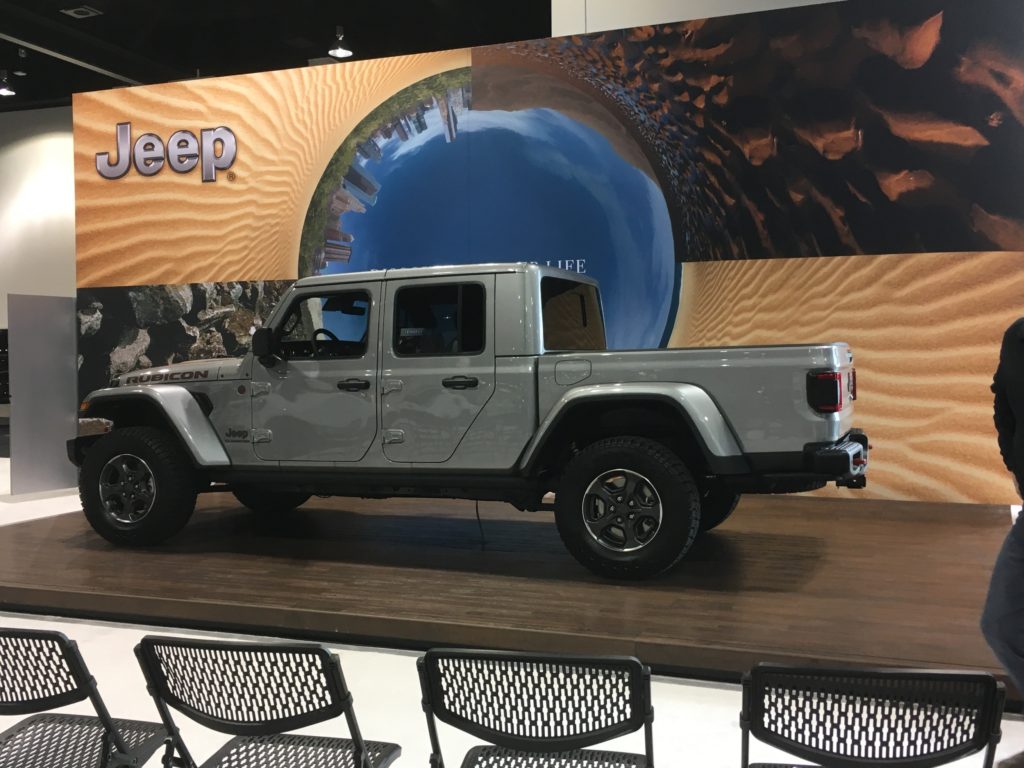
Making its debut Wednesday in Denver was the 2020 Jeep Gladiator. (Jan Wells photo)
Entries into
the midsize truck market by Ford and Jeep were “big” draws at the 2019 Denver
Auto Show, which ended a five-day run in late March at the Colorado Convention
Center.
Ford drew its
share of attention at the opening of the show, first for what was there – the resurrected
Ford Ranger – and, also, for what wasn’t there – the Mustang Bullitt. Jeep
unveiled the 2020 Gladiator, its first pickup since the Comanche went away in
1992.
The Ranger,
with larger dimensions and roomier interior, is back after an absence of seven
years, and along with the Gladiator will take aim at hot-selling rivals Toyota
Tacoma and Chevy Colorado, as well as the GMC Canyon and Nissan Frontier.
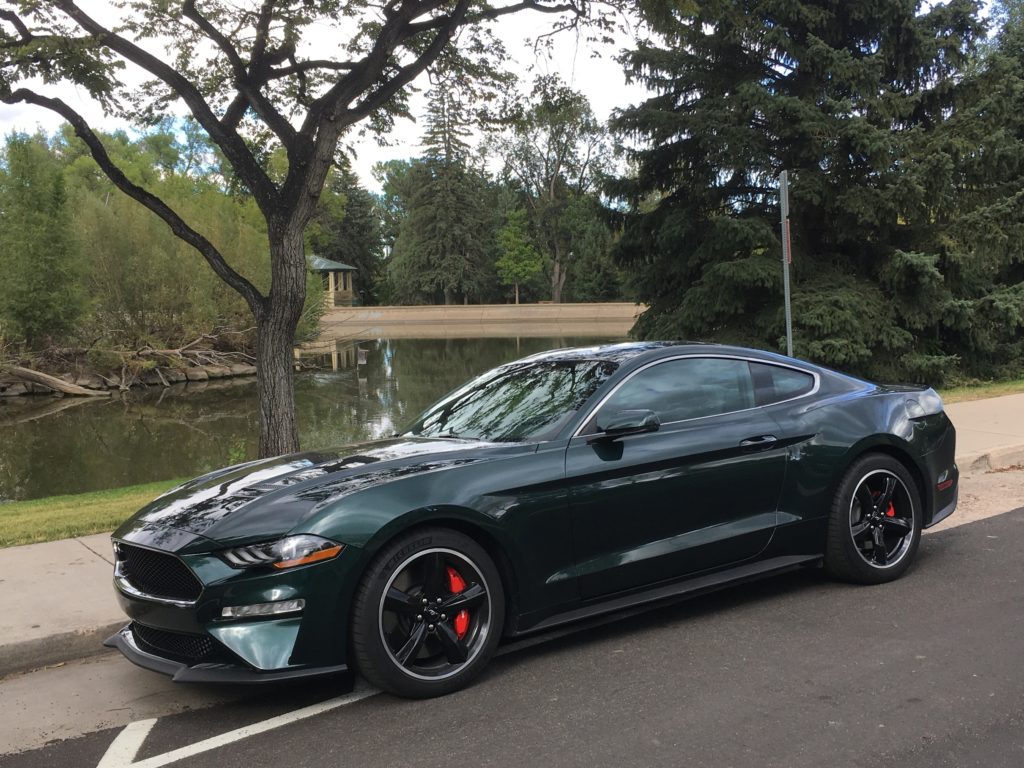
Car of the Year at Denver Auto Show is the Ford Mustang Bullitt. (Jan Wells photo)
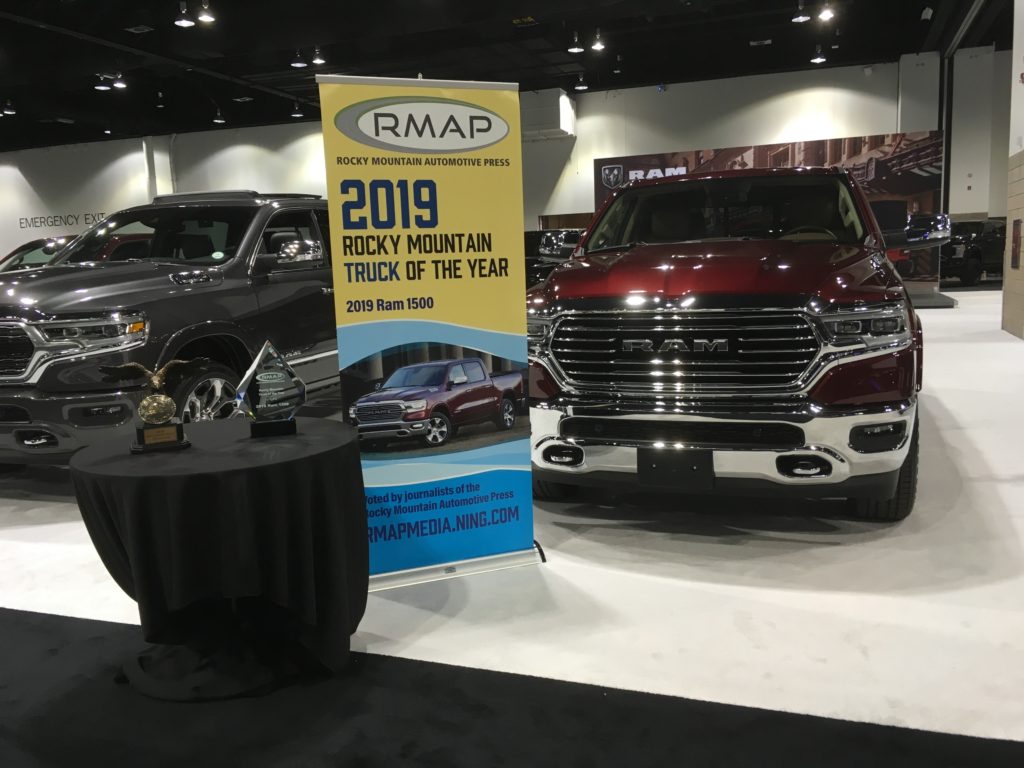
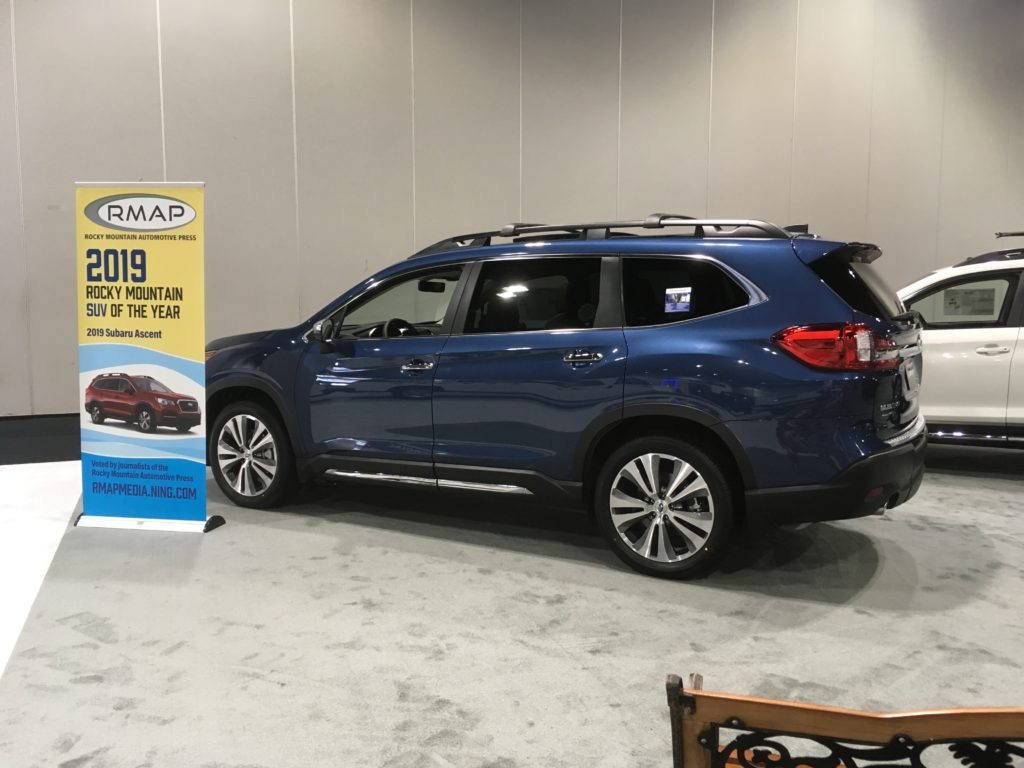
The Ford Mustang Bullitt, at the Gala Tuesday night kicking off the car show, was named Car of the Year in voting by members of the Rocky Mountain Automotive Press. The Ram 1500 was chosen Truck of the Year and Subaru Ascent is SUV of the Year.
Thirty
minutes following those awards, presented by RMAP president Craig Conover,
Leonard Kanonik was the first of many mentioning to me that the large Ford
display didn’t include a Bullitt.
Crowds poured
into the convention center hall Wednesday evening at the official opening of
the show. Up front at the showroom floor were Toyota and Chevrolet displays; the
Toyota lineup included its first-to-the-U.S., all-wheel-drive capable Prius
Hybrid AWD-e.
The Ram 1500 was named Truck of the Year at the auto show. (Jan Wells photo)
To earn Car
of the Year honors, the ’19 Bullitt was picked ahead of the ’19 Volkswagen
Jetta, ’18 Mazda6 Signature and ’18 BMW M5. The ’19 Ram outpolled the ’18 Ford
F-150 Raptor and GMC Sierra AT4 as Truck of the Year; the ’19 Ascent was chosen
as top SUV over the Volkswagen Atlas, Nissan Rogue SL and Chevrolet Traverse,
all ‘18s.
After first
glance at the impressive 2019 Ford Ranger on the floor of the Colorado
Convention Center, an oft-heard comment was, “It is much larger than the old
one.” How much bigger? After an absence
of seven years, the Ranger returns with wheelbase which has grown by 1 ½
inches, overall length is more than a foot longer, width is more, its taller and
curb weight is 700 pounds heavier at 4,200.
The four-door
Gladiator, which goes on sale in the coming month, is 219 inches in overall
length, 31 inches longer than the Wrangler Unlimited four-door. An 8-speed
automatic transmission or 6-speed manual will be available with the 3.6-liter
Pentastar V-6 engine (up to 7,650 pounds tow capacity). A 3.0-liter ecodiesel
V-6 will be available for 2020.
The Subaru Ascent outpolled three other finalists as SUV of the Year. (Jan Wells photo)
I’ve driven
the 2019 Ford Ranger Lariat SuperCrew 4X4, the most expensive trim level for
the truck. Its sticker price is $45,190. The cheapest Ranger 4X4 is the XL
SuperCab, which begins around $29,000.
Power is from
a 2.3-liter EcoBoost 4-cylinder, with 10-speed automatic transmission. There is
no lack of power, though occasionally in low speeds it seems often to move up
two or three gears and lug a bit, then awaits coaxing to drop down to more
responsive rpm.
With the
optional FX4 OffRoad package, suspension has been firmed up. It rides on Hankook
265/60R18 tires.
Its 20.7 fuel-mileage
average is higher than I’ve attained in a Toyota Tacoma or Nissan Frontier. The
only gas-engined compact truck that has topped the Ranger for me was a 2018 GMC
Canyon with 3.6-liter V-6 that averaged 21.2 last summer.
Back and forth at the auto show
Tim Jackson, Bud Wells and George Karl await opening of the Denver Auto Show. (Tim Jackson photo)
Standing alone at the entrance to the convention center auto show floor, popular Nuggets’ coach George Karl graciously agreed to have his photo taken with me, and with Tim Jackson. Might he coach again? Well, he didn’t say no. . . . . What Cadillac might have been the favorite automobile through the years for Debi Medved, stylish wife of megadealer John Medved. It wasn’t a Cadillac at all, she told me at the car show – it was the big, burly Hummer H2. “And I also drove the Hummer H1 and Hummer H3, and liked them, too,” she said. The Hummer went out of production in 2009. . . . . Amid all the glitter of the new cars, Grand Junction Republican freshman representative Matt Soper, with Sarah, expressed his eagerness for the legislation task at the State Capitol. He represents Mesa and Delta counties. . . . . Seeking late-night dessert at Peaks on the 27th floor of Hyatt Regency Denver following the Tuesday night Gala preceding Denver Auto Show, Mike Van Duzer, of Chicago, made room at crowded bar for Jan and me to order, then bought our fondue dessert for us. Van Duzer, in Denver for US Foods convention at the Hyatt, is a big baseball fan, and happy for Denver over signing of Nolan Aranado, but not sure the Rockies will prevail over his Cubbies this season. . . . . Victory Motors Ram/Jeep dealer Steve Maneotis, of Craig, was thrilled to come across Villager publisher Bob Sweeney at the show. Sweeney, who published the Craig paper before moving to Denver and opening the Villager, was a friend of Maneotis’ father, Tom, in Craig. . . . . Jan and I, enjoying the early Wednesday morning street view from Starbucks on the Sixteenth Street Mall, saw a familiar face from 15 years ago, that of Derrick Johnson, delivering bakery goods to a lower level. Back in the early 2000s, he delivered new cars to me from Thompson Communications, including a rear-drive BMW which became stuck in deep snow two blocks from my home in Greeley and had to be towed to the driveway. He’s now a lead driver for Izzio Bakery.
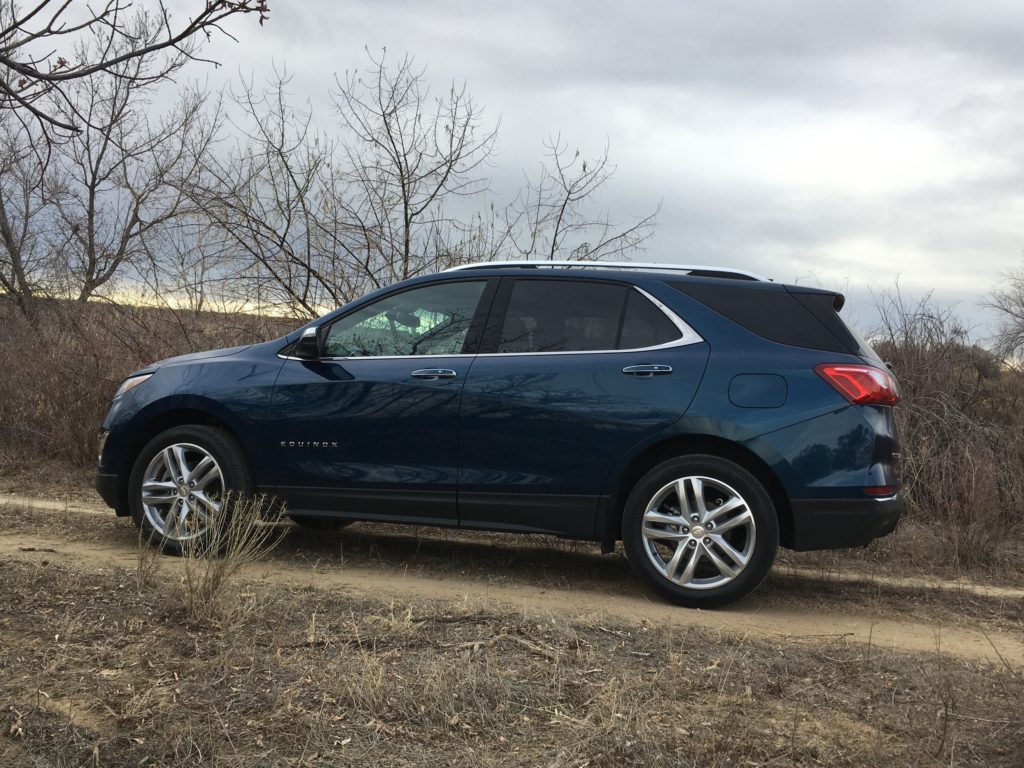
Since its resizing, the 2019 Equinox competes in the compact crossover field. (Bud Wells photo)
As General
Motors pursued plans for eliminating several Chevy and Cadillac sedans and
shutting down some car plants, a bright spot in the middle of all the
discussion is the Equinox, one of the five best-selling compact SUV crossovers
in the country.
Those of us
who have been around for quite a while still think of GM and Chevrolet for
their big, tough, good-riding SUVs – the Suburbans, Tahoes and Yukons. Chev’s
bread-and-butter models, though, are the Equinox and Traverse crossovers.
The Equinox,
on its unveiling in 2004 as an ’05, was the company’s first departure from
those truck-based sport utes. It was a practical alternative for families
seeking to lower their investment in car-carrying responsibilities.
Five years
after its introduction, the midsize Equinox was redesigned, then a year ago it
took on a new look and was resized into a compact crossover. A shedding of 400
pounds let it run lighter and more efficiently.
The new 2019 Equinox,
5 inches shorter than the ’17 model, shapes up very close in dimensions to one
of its primary rivals, the Jeep Cherokee. Here is the comparison: Wheelbase-
Chevy 107.3 inches, Jeep 106.5; Length- Chevy 183.1, Jeep 182; Width- Chevy
72.6, Jeep 73.2; Height- Chevy 65.4, Jeep 65.7.
Experiencing the
comfort, handling and performance of the Chevy was enjoyable. Seating is very
supportive and the MyLink infotainment system, including Android Auto and Apple
CarPlay, is user-friendly. The interior was very quiet; heavy use of plastic
detracted somewhat.
The Equinox
took a hit on cargo space through its resizing last year; its 29.9 cubic feet
behind the rear seats is smaller than most compact competitors.
The review
model I drove was equipped with the optional 252-horsepower, 2.0-liter
turbocharged 4-cylinder engine, and, mated to a 9-speed automatic transmission,
was impressive. Good low-end torque got it off the line okay, and it was smooth
at higher speeds and on demands for passing other traffic. Fuel mileage
estimates are 22/28, and my overall average was 26.3. It has the stop/start
fuel-saving feature. Turning circle of the Equinox is a bit wider than most
competitors; it rides on Hankook 235/50R19 tires.
Base engine is a 170-hp, 1.5-liter turbo
4-cylinder with 6-speed automatic transmission. To opt for this engine is to
give up quick, smooth shifts and contend with quite a power decline, though
this combo carries a good EPA rating of 26/32 mpg.
The
well-equipped Premier edition of the Equinox needed only one optional package,
Confidence and Convenience at an added cost of $2,145. It included eight-way
power front passenger seat, ventilated front seats, heated second-row seats,
heated steering wheel, low-speed forward automatic braking, forward-collision
alert, lane-keep assist with lane-departure warning, following-distance
indicator, safety alert seat, automatic high-beam control, adaptive cruise
control, front pedestrian braking and surround vision.
This brought
sticker price to $37,745. Among standard items are a hands-free power liftgate,
remote vehicle start, dual-zone automatic climate control and wireless charging
device. Cheapest Equinox AWD trim level begins at around $26,500. The Equinox
is built in Ingersoll, Ontario, Canada.
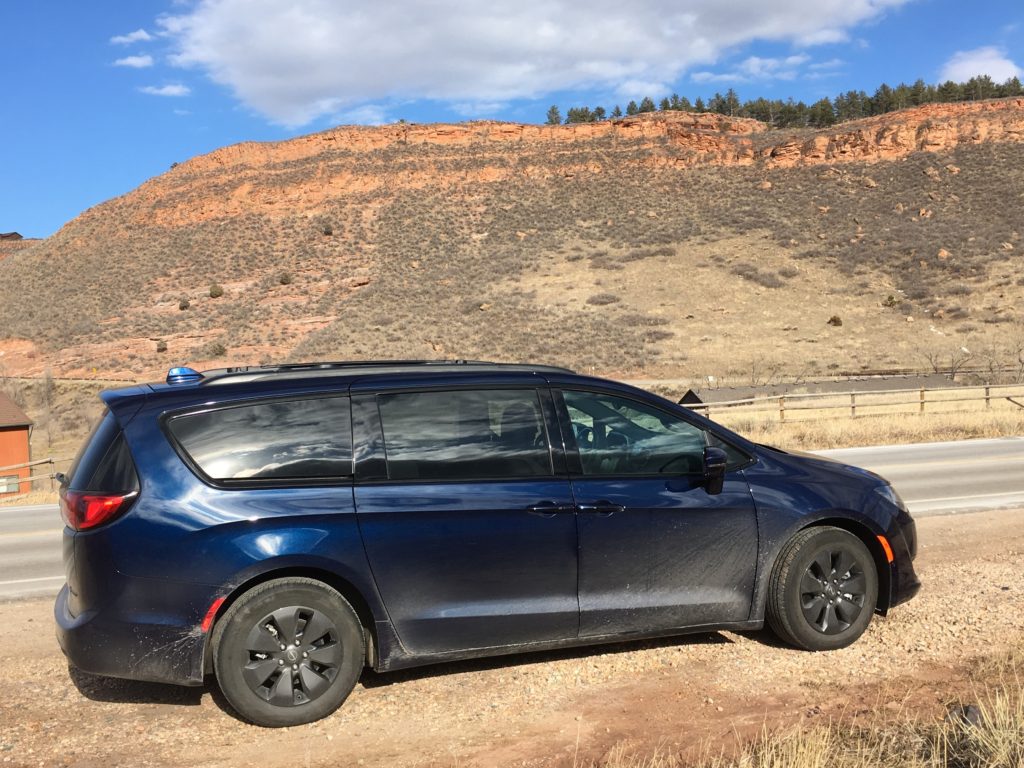
The Chrysler Pacifica Hybrid is empowered by V-6 and two electric motors. (Bud Wells photo)
The 2019
version of one of the Rocky Mountains’ greatest springtime events, the Denver
Auto Show, will open its doors to the Colorado Convention Center on March 28,
preceded on March 27 by the Preview Gala featuring former Denver Nuggets’ coach
George Karl.
In
preparation for walking among the burgeoning nameplates devoted to electrics
and hybrids, I’ve driven the 2019 Chrysler Pacifica Plug-in Electric. The most
technologically advanced minivan on the market, it features an electronically
variable transmission tied to two electric motors, a battery pack and
3.6-liter, V-6 gas engine. It delivers 33 miles of full-electric-drive range,
and often tops 30 miles per gallon in combined fuel mileage.
The auto show
extravaganza is its 42nd consecutive since Bill Barrow resurrected
the show after being hired to oversee the Colorado Automobile Dealers
Association (CADA) in 1977. In sorting through old newspaper files of mine, I
came across a column from May 1978 promoting the Denver Auto Show after its
absence of 11 years from the city.
It listed the
names of car dealers who assisted Barrow in organizing the show, May 31 through
June 4, 1978, at Currigan Exhibition Hall. It was a big deal and their names
perhaps ought to be commemorated. Teaming with Barrow, the dealers on the 1978
auto show committee were Hugh Tighe, Steve Dowson, Joe Fadely, Ann Goodro,
Johnny Haas, Bud Karsh, C.F. Pansing, Bob Post, Chuck Ruwart and Ken Stiner.
Back in those
days, I borrowed Dodges from Tighe, Oldsmobiles from Dowson, Fords from Ms.
Goodro, Mercurys and Lincolns from Haas and Volvos from Karsh for my reviews in
The Denver Post.
The 2019
edition of the big show is headed by Tim
Jackson, president of CADA, and Fletcher Flower of Flower Motor Co. in Montrose,
who is auto show chairman. Jackson, who succeeded Barrow in 2005, has earned
national recognition for his travel all over the country on behalf of auto
industry issues; an opinion column of his was featured in Automotive News of
Detroit. Flower’s dealership is one of three which has operated more than 100
years in Colorado (the others are O’Meara and Schomp).
The recent cold,
snowy weather took a toll on the hybrid performance of the Chrysler Pacifica,
lessening its 33-mile all-electric range a bit and dropping a three-day fuel
check to 26.6 mpg. In later mild temps, though, and after a plug-in partial
electric charge to 13 miles, Jan and I enjoyed a 70-mile drive to Masonville
and on through the hills past Horsetooth Reservoir near Fort Collins. The
electric-mode torque provides excellent low-end acceleration, and overall fuel
mileage was 34.5. In addition to the 13 miles on electric power, regenerative
braking produced added miles to that of gasoline power.
The
260-horsepower combined engine/electric motor output seems sufficient for the
5,000-pound van, and its new (evt) transmission is smoother than its standard
9-speed automatic.
It has an
effective lane-assist system, though perhaps a bit too immediately severe for
75-miles-per-hour travel; the tops, in my opinion (Mercedes and Audi), use a
more-gentle nudge back toward center-lane. Chrysler has also equipped the
Pacifica with optional forward-collision warning, adaptive cruise and parallel
and perpendicular park assist.
The Pacifica,
built in Windsor, Ontario, Canada, teamed with the Dodge Grand Caravan as the
two top-selling minivans in the country last year. In its hybrid form, unlike
the standard gasoline-powered Pacifica with stow ‘n go, the hybrid’s second-row
seats can’t be folded into the floor, for that space is devoted to the battery
pack. The third row, however, will flip back flat into the floor and expands
cargo space from 32 cubic feet to 87.5.
Sticker price
on the Chrysler Pacifica Hybrid Limited is$50,375.
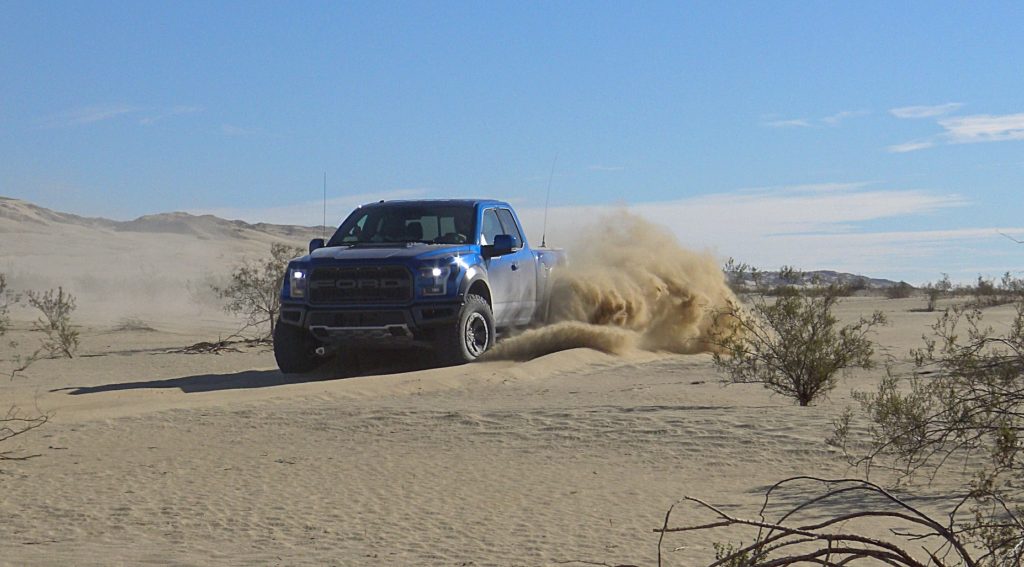
A powerful front-end look identifies the Ford Raptor (Bud Wells photos)
Even with its
oversized presence and accompanying parking concerns on occasion, I looked
forward every morning for a week, walking out and climbing up into the
high-riding 2019 Ford F-150 Raptor 4-by-4, and driving, and driving.
The Raptor
was at its best whether the drives were short runs about town, or to the west into
the beautiful Big Thompson Canyon, or, especially, during a bit of offroading.
The
performance of Ford’s EcoBoost High Output V-6 engine is outstanding; there’s
no longing from me for a V-8. Tied to a 10-speed automatic transmission with
paddle shifters, the second-generation EcoBoost is of twin-turbocharging and
reaches 450 horsepower and 510 lb.ft.of torque. It is strong and fairly
effortless, with excellent sound from its dual exhaust.
The
Supercrew’s big-tread tires, Goodyear All-Terrain LT315/70R17s, are for
roughing it offroad, yet the Raptor lends a smooth ride in and out of the city.
Oddly, though, there is no apparent fuel-mileage gain with the smaller V-6
block. I averaged 15.4 miles per gallon in overall driving.
The Raptor
easily maneuvered the bends of the Big Thompson Canyon roadway, while providing
good ride comfort, as well. Ford’s ’19 version met the challenge of the curves
with new Fox Live Valve internal bypass shocks that electronically adjust
damping, using sensors in the suspension and body to maximize comfort, handing
and bottom-out resistance.
Three modes
for the suspension are Normal, Off-Road and Sport, and the Raptor’s terrain
modes include Normal, Sport, Weather, Mud/Sand, Baja and Rock Crawl, selected
by pushing a button on the steering wheel.
Paddles on the steering wheel help control all the downshifting and upshifting, and a 1-through-10 ladder on the instrument panel tells at a glance where the gear is set.
The review model
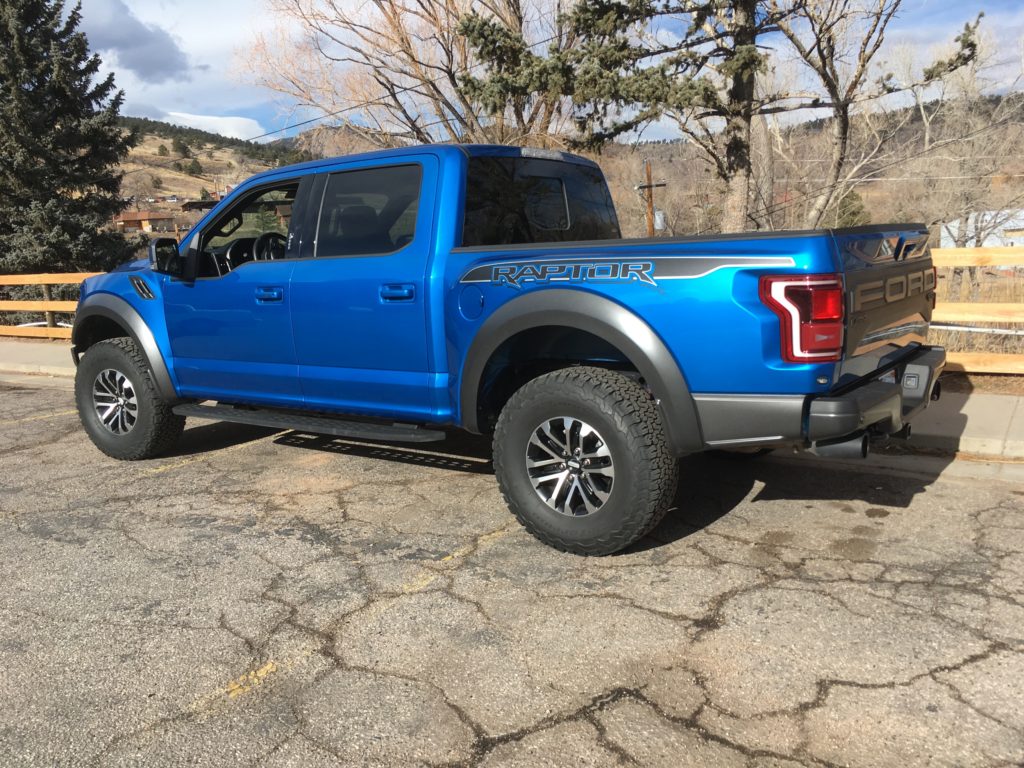
is finished in bright velocity blue color; the interior is highlighted by blue
accent and Recaro seats.
The 2019 F-150 Raptor is finished in velocity blue.
Access is eased by
7-inch-wide running boards; adding pleasure once inside are a twin-panel
moonroof, Bang & Olufsen sound, voice-activated navigation and heated seats
front and rear.
Heading a long
list of other safety and performance amenities are adaptive cruise, automated
emergency braking, blind-spot with trailer-tow monitoring, trailer-sway
control, inflatable rear safety belts, rearview camera, electronic 4-by-4
shift-on-the-fly, pro-trailer backup system and terrain management.
The high-pressure
turbo and the many add-ons boosted sticker price for the new Raptor to $70,700
from a base of $57,335.
Parking concerns
on occasion come from the extra-wide Raptor body. With both front doors
fully open, the Raptor is 10 inches wider from door-tip to door-tip than my
four-door 4-by-4 pickup when opened likewise.
Remote start
is activated by pushing one of five buttons on the remote key fob. It and the
button just beneath it are marked “2X,” indicating it must be pushed twice
quickly for response. Push the wrong one and,instead of walking outdoors to a
warming engine, the truck will be sitting there, cold as ever, with a dropped
tailgate.